
Campus
Two Study Centers in the heart of Syracuse.
A gateway for international students and scholars to unlock academic resources, cultural heritage and Mediterranean opportunities.
With two state-of-the-art Study Centers and longstanding partnerships with local research and higher education institutions, The Italian Academy serves as a gateway for international students and scholars to unlock the wide array of academic resources and opportunities available in Sicily and in the Central Mediterranean region.
City Campus
Two locations, one academic ecosystem.
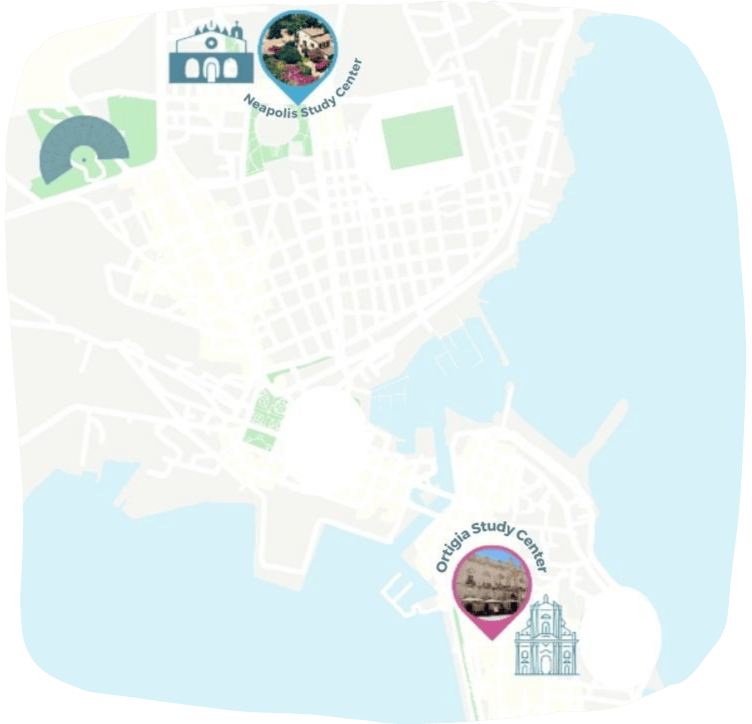
The Italian Academy connects students to the historic, cultural and academic fabric of Syracuse through two complementary Study Centers: one in Ortigia, the historic heart of the city, and one in Neapolis, surrounded by archaeology, nature and learning spaces.
Rooms
Students
Teachers
Staff members
A strategic starting point
Explore Sicily and the Mediterranean while immersed in its cultures.
Inspire
Our mission is to inspire each student to learn by nurturing intercultural understanding and critical thinking immersed in the Mediterranean context, aiming to support a network of global citizens who will contribute to holistic sustainable development and peace.
Connections
By fostering these connections, we believe in the transformative power of international education to create a ripple effect, encouraging a broader understanding and appreciation of global citizenship that transcends borders, and empowers individuals to enact positive change in communities around the world.
Study Centers
Historic places designed for contemporary learning.
Ortigia Study Center
Inside Palazzo Beneventano del Bosco, in Piazza Duomo.
Located on the island of Ortigia, in the 14th-century Palazzo Beneventano del Bosco, set in the most charming square in the city, Piazza Duomo.
The late-baroque style palazzo faces the Municipio, the Town Hall, and the Duomo, the Cathedral, both of which were erected on the ruins of two Greek temples, respectively the temple of Artemis and of Athena.
The Piazza Duomo square sits on the site of the ancient Greek city’s acropolis, bearing witness to which is the majestic doric colonnade on the northern side of the cathedral. Enclosing a charming courtyard paved in ornate cobblestones, the Palazzo is a perfect example of late baroque architecture.
A building of great historical importance
Seat of the local government during the Spanish domination, in 1798 it hosted the English admiral Horatio Nelson during the Napoleonic Wars, before the battle of Abukir, and in 1806, Ferdinand I, King of the Two Sicilies.
Neapolis Study Center
A peaceful oasis in the archaeological district of Syracuse.
The Neapolis Study Center is located in the center of the archaeological district of the city of Syracuse, Sicily, adjacent to St. John’s Church, which gives access to its Catacombs network: considered one of the first places of Christian worship in the West.
The historic villa is also adjoining the Archaeological Museum and the Basilica of Our Lady of Tears, while the Greek Theater and the island of Ortigia are at a short walking distance.
The historic villa boasts two acres of lush botanical garden filled with citrus trees, Mediterranean flora, century-old palms, as well as many other exotic plants.
“You have often heard that Syracuse is the largest Greek city and the most beautiful of all. Gentlemen, it’s just like they say.”
Citrus trees, Mediterranean flora, century-old palms and exotic plants.
Archaeological Museum, Catacombs, Basilica and Ortigia within walking distance.
Study in Sicily